
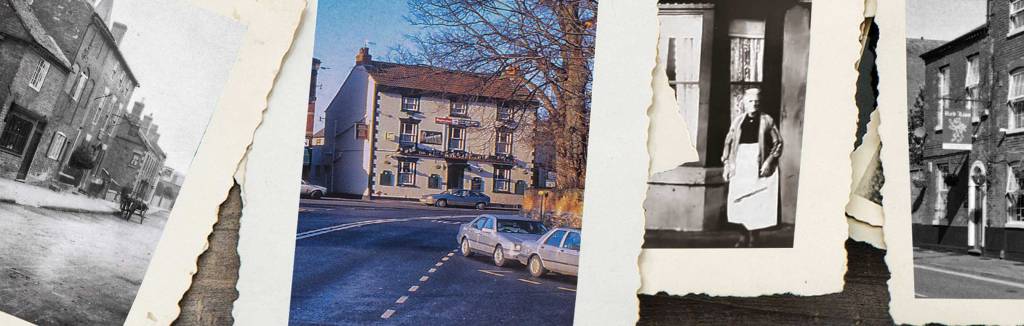
A walk around the pubs of Kegworth – past & present.
In 1901 Kegworth’s population was around 2100 and there were 14 pubs. Three breweries also came and went, with the last disappearing in 1924. This heritage trail celebrates their history and invites you to support those that are still in operation. The total walk is about 2 miles (3.2 km).
Let’s start in the Market Place. Facing the church, the building on the corner to your left was once a pub – The Lantern. Most recently this became Jee Ja Jee’s Indian restaurant.

1. The Lantern
Originally this was a house owned by the Knowles family – drapers in the village. The adjacent building was home to one of the village’s shortest lived boozers; The Crane & Wells. The Lantern itself was a short lived pub opening around 1996 and gone within ten years. It is said to be haunted. Wells Brewery was sited to the left where there is now a modern office block and operated until 1924 when it was acquired by Worthington & Co of Burton on Trent and brewing ceased. Staying on Market Place, the site that became the Soar Trading Co shop, was formerly:
2. The Horse & Groom
Many of Kegworth’s pubs have had several name changes and this is one such. It started its pub life as King William IV, was renamed The Crown, but by 1876 was The Horse & Groom. In the 1950’s the landlord had a Myna bird renowned for its bad language ! In the 1970s it closed as a pub and became a laundrette.
Let’s now leave the Market Place and turn into London Road:
3. The Dog and Gun
Not a lot to see now. A coaching inn of this name is listed in Pigots Trade Directory 1840. This was the year that the railway serving the village was opened. The arrival of the railways lead to the demise of coaching routes and the businesses that served them. Was this one of them? Previous writings on Kegworth pubs refer to a stone block bearing the date 1703 marking the site. There is a stone block with the date 1701 on the right hand side of London Road; could this be the site of this pub?
4. The Three Tuns
Another that had a name change. Originally The Three Tuns was located on the High Street, see The Crown. In 1851, it was on the High Street but by 1871 the name had transferred to London Road. There may have been a pub here from 1862, which may have been called The Plough but this is not certain. It closeda s a pub in 1910. Continue down London Road and, opposite the Whatton Road junction you will find:
5. The Britannia Inn
There was a pub of this name here pre 1849 but the original was demolished and its replacement built in the Mock Tudor style of the 1920s and 30s that can also be seen in The Flying Horse and The Anchor. It closed in 2011 and became student accommodation. A new built block was constructed in its grounds bearing the name Cross Keys House, an acknowledgement of another of the village’s former pubs. Retrace your steps back up London Road and, roughly where the parish office is now, you will find the site of the former:
6. Old Three Cranes
This was certainly a pub by 1809 and remained as such until the 1930s when it was demolished as an unsafe building. Continue into Nottingham Road, turning right into Mill Lane and then take the footpath off to the right, Bridgefields. The footpath exits onto Station Road after passing through the car park of our next pub:
7. The Anchor Inn
The adjacent River Soar was canalised in 1778. Boating folk like a little refreshment and their needs were served by The Old Woolpack . By 1828 it had become The Anchor, in 1875 it was known as The Old Wool Pack. In 1933/34, when it was, once again The Anchor, part of the original building was demolished and the frontage that we can now see was added in the Mock Tudor style. Now head west on Station Road continuing into Side Ley were we will find the site of:
8. The Cross Keys
There is even less left of this one than the Dog and Gun but, next to number 10 Side Ley, there was once a pub. It was listed in Wright’s Trade Directory of 1874 and survived as a pub until 1929. The building was demolished in the early 1970’s. Cross the road now and enter Sideley Park and follow the main path until it reaches the gravel path on the left, take this into Queens Road. Continue south and you will encounter the next of our pubs on Borough Street.
9. The Cap and Stocking
Now it’s on Borough Street but the original Cap was on Cap & Stocking Lane ( it’s not only pubs that change names). The name of the pub reflecting what was one of the village’s main industries; the hosiery trade. The original building was demolished in 1910 to make way for the current building.
Many locals will recall the bird and fish room with its stuffed specimens. Also noted for “Flat Bass” – served not by beer engine but from a jug. Now follow Borough Street up the hill for a few yards and then turn right into the Birdcage footpath. Take the left fork and you are on a footpath known as Benny’s Hill. This will lead you to Derby Road and our next pub. The name of the footpath is associated with our next pub.
10. The New Inn
This building became a Chinese takeaway, which was adjacent to the path but was the New Inn. The pub is mentioned in Pigot’s Directory of 1822 when it would have been situated on a cul-de-sac road; Derby Road not becoming a through road until Victoria was on the throne. In the 1950’s the landlord was Reginald Breakwell, known as ‘Benny’. Many of those growing up in the village will recall the first week of the summer holidays being spent sitting on the front wall of the pub and watching Holland’s fair pulling onto the adjacent ’Wakes Field’ (now Hollands Way). It ceased being a pub in the 1990’s.
Cross the road and continue right on Derby Road in the direction towards the motorway. You will pass the site of Kegworth’s second brewery, the Springwell Brewery (look out for the house named Leicester House). This brewery operated from 1870 until 1888, was then sold to Marston Brewery Co and production ceased.
Continue until you find a footpath on the left that will lead us across the Ropewalk and onto Packington Hill. Turn left and climb the hill to an open piece of land which is now a car park. This was once the site of:
11. The Oddfellow’s Arms
The Oddies (as it was known) was listed as a village pub in 1840 but the last building here was Edwardian. A stranger entering the pub in the 1990’s would have thought Keworth folk mad if he or she encountered the ‘Hat Club’ whose members were required to wear a hat at certain times or be fined (for charity). Continue up Packington Hill until you come to a crossroads. On the Packington Hill/ Ashby Road corner you will find our next pub:
12. The Fox and Hounds
Listed as a pub from 1875 to 1974 when it became a private house. A landlord in the 1920’s kept a fox as a pet. Now turn left into High Street where we will find some pubs that are still open. With your back to the school, to the left of Plummer Lane the building here was once:
13. The Crown
This was originally called the Three Tuns. Locals will know of the ‘Ghost Tunnel’ that takes a footpath from the river bridge to Kingston under the railway. In one version of the story the ghost here is said to be of a railway navvy killed in a fight, in the Three Tuns, when the railway was being constructed. The Midlands Counties Railway was built in the late 1830’s; Kegworth Station and the line opening on 5th May 1840. Unless the reference is to later railway work, this then must be the Three Tuns of that story and not the one on London Road. It was renamed The Crown between 1851 and 1874 and closed, as a pub in 1911. Villager baby boomers will recall the building housed Lottie Stockton’s sweetie shop, a veritable cornucopia of confectionary delights. Now numbered 32 High Street.
14. The Red Lion
Orignally the Horse and Groom in 1789, it became The Red Lion in 1870. This Georgian building was constructed during the period when the Window Tax (1696-1851) was in force and the ‘blind’ windows to the front elevation are probably as a result of the tax.
15. The Coach House
A relative newcomer to the village, located opposite the Red Lion. Unfortunately there is very little history recorded about this pub that is now a friendly and quaint guest house in Kegworth.
16. The Concorde/Fosters Arms
Nothing to see of this one; a modern office building next to the Baptist Chapel is on the site. In 1904 Kelly’s Directory states that it was a house named The Chestnuts and was occupied by brewer Sidney Wells. It was said to be haunted by an old lady, wearing a long dark dress and with head and shoulders bowed. During the 1970s it became the Concorde Hotel but by 1980 it had changed name to Foster Arms. A photograph shows the name above the door as Foster but the pub was included in the Kegworth Village Guide of 1988 where it is listed as Fosters. It closed in the late 1980’s and was demolished.
17. The Flying Horse
The original ‘Fly’, as it was known, was in a building next to and in line with that housing the Hidden Gem café. Originally it was The Black Swan , a coaching inn on the route from London to Derby. The name changed in 1796 to the Old Flying Horse Inn, by 1896 it was Ye Olde Flying Horse. In 1929 the original building was damaged by fire and replaced in 1930 by the current building in the Mock Tudor style. It survived as a pub into the current century but not for long, becoming Oaklands butcher’s shop and Deli most recently.
Not mentioned: Premises like restaurants, that may have had a bar, working mens’ clubs and pubs outside the village, e.g. The Otter. Also Kegworth’s third brewery, Byng’s Brewery 1839-1841, simply because its location is unknown.
Credits & Acknowledgements:
- Billy’s Book of Kegworth Boozers
- Kegworth Aspects of History
- The Kegworth Village Guide 2nd edtion 1988 The Midland Counties Railway 1839-1989 James McKay
- Jerry Tseng for the village map
Pick up your free copy from The Soar Trading Co Market Place, egworth Library, Kegworth Parish Council Offices, St Andrew’s Church, Kegworth Baptist Church, Dog & Jones, Lovage Homes, Kegworth Surgery, Kegworth Co op, Kegworth Village Hall. Pop into our local shops & cafe whilst you are on your trail.
 One Kegworth